Summer Walks: Keeping Dogs Safe When Temperatures Climb
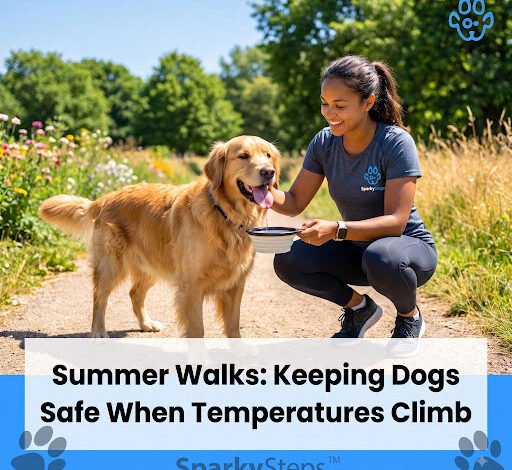
Heat causes more walk related emergencies than most owners expect, and a lot of them are avoidable with a bit of planning. Dogs cannot regulate temperature the way people do. They rely mainly on panting rather than sweating, which makes them far more vulnerable to overheating than owners sometimes realize, especially on days that do not even feel that extreme to a person.
Why Dogs Overheat Faster Than People Assume
A dog’s cooling system is simply less efficient than a human’s. Thick coats, especially on double coated breeds, trap heat close to the body. Flat faced breeds like bulldogs and pugs struggle even more, since their airways are already somewhat restricted before heat becomes a factor at all.
Humidity makes this worse. Panting cools a dog by evaporating moisture, and when the air is already saturated with moisture, that evaporation slows down significantly, meaning a humid seventy five degree day can be more dangerous than a dry ninety degree one.
The Pavement Problem
One detail gets missed constantly, pavement temperature is not the same as air temperature. On a sunny eighty five degree day, asphalt can reach well over one hundred and forty degrees, hot enough to burn paw pads within seconds of contact.
A simple test works well here. If the back of a hand cannot be held comfortably on the pavement for seven seconds, it is too hot for a dog’s paws. Grass, dirt trails, or shaded routes are far safer choices during warmer months, and walks are generally best scheduled early morning or evening rather than midday.
Owners who want a second set of eyes on timing sometimes look into local dog walking services that can shift a dog’s walk to cooler parts of the day when the owner’s own schedule does not allow for it.
Signs of Overheating to Watch For
Heatstroke can escalate quickly, so recognizing early signs matters:
Heavy panting that does not slow down even after stopping to rest.
Bright red gums or tongue, which often signal the body is struggling to cool itself.
Excessive drooling combined with lethargy or a sudden lack of coordination.
Vomiting, or in more severe cases, collapse, both of which require immediate veterinary attention.
If any of these appear, the walk should be stopped immediately, and the dog moved somewhere shaded and cool right away, with water offered in small amounts rather than a large sudden volume.
Making Summer Walks Safer
A few adjustments that reduce risk significantly:
Timing the walk for early morning or after sunset, when both air and pavement temperatures are noticeably lower.
Bringing water on any walk longer than fifteen or twenty minutes, along with a portable bowl.
Choosing shaded routes over direct sun whenever a reasonable option exists nearby.
Shortening the walk itself on especially hot or humid days rather than pushing through the usual distance out of habit.
A more detailed seasonal breakdown, including specific guidance for brachycephalic and heavy coated breeds, is covered on the blog for anyone wanting to go deeper on this.
What About Shaving a Heavy Coat
This comes up a lot in summer, and the answer is more nuanced than it seems. For most double coated breeds, the coat actually insulates against heat as much as cold, and shaving it can remove that protection while also increasing sunburn risk. A trim to manage matting is usually fine, but a full shave down is generally not recommended without a vet’s input specific to that breed.
When Timing Gets Hard to Manage
Summer schedules get complicated fast, especially with kids home, travel, and longer daylight hours shifting everyone’s routine. For owners who cannot reliably hit the cooler parts of the day themselves, this is often when a midday or early morning visit from someone else gets considered. Working out what a heat safe walking schedule could look like for a specific dog is usually easiest through a direct conversation rather than trial and error during a heat wave.
The Bottom Line
Summer heat is manageable with the right timing and a bit of awareness, but it is not something to treat casually. Testing the pavement, watching for early signs of overheating, and shifting walks to cooler hours cover most of what actually matters. If summer scheduling is the real obstacle, reaching out before the hottest stretch of the season hits is a reasonable step to take early rather than after a close call.


